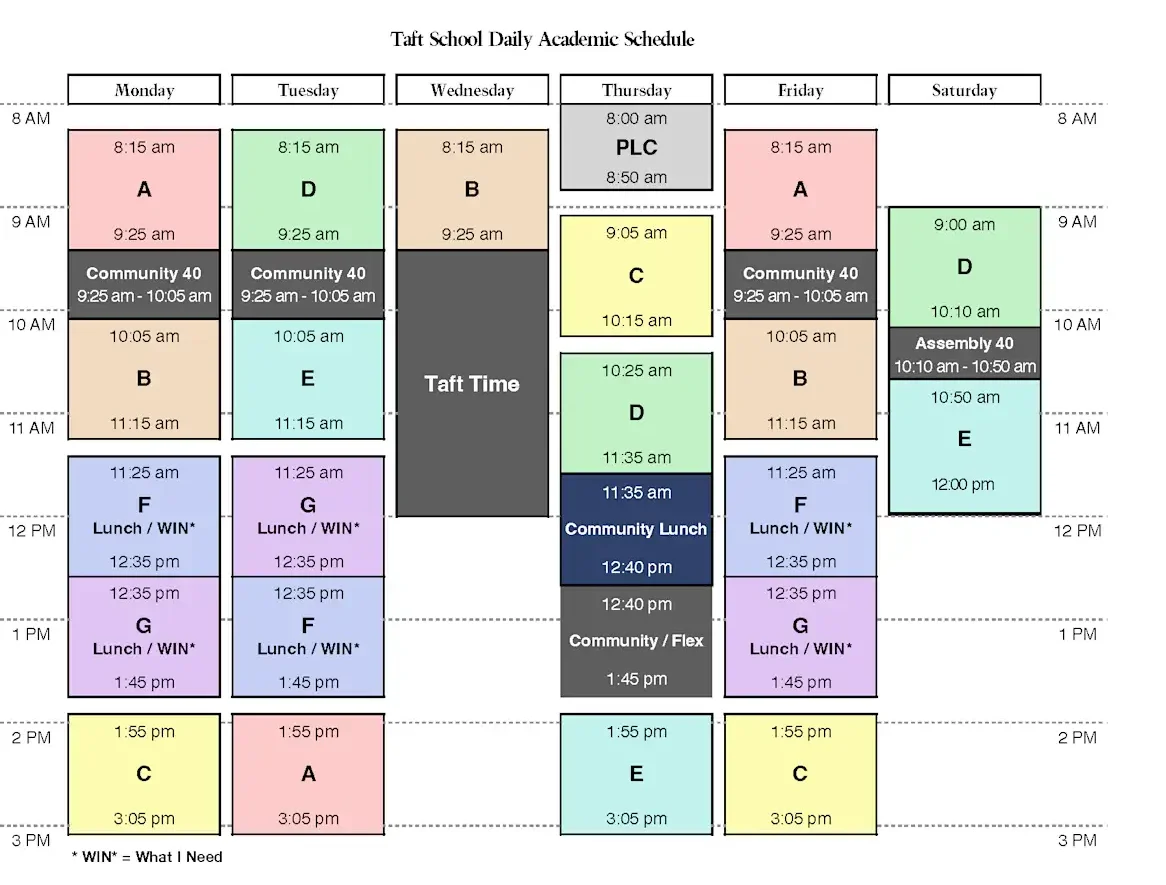

As we arrive back on campus this spring, two subjects keep appearing in everyone’s conversations: the new school schedule and the newly locked doors around campus.
To begin with, the new door policy has been hard to ignore. With the new security protocol, almost every exterior door is now locked at all times, and if you don’t have your fob, you’re not getting in. On one hand, it’s easy to understand why this is happening. Schools everywhere are taking a more serious look at who can access campus spaces, and frankly, safety is a top priority. But in reality, the change has just made everyday life a bit more frustrating.
Having to bring your fob everywhere means an extra thing to remember every morning before you leave your room. Forget it once, and suddenly you’re texting a friend to let you in, waiting awkwardly by a door, or rethinking your entire plan.
If the locked doors are a mild annoyance, the new school schedule next year sparks much more controversy.
When Taft announced its redesigned daily schedule, we could agree that it came wrapped in all the right intentions: deeper learning and more flexibility. However, when we really start thinking about what a day-to-day routine looks like, it becomes clear that the schedule only succeeds in making things more confusing.
At the center of the redesign are seventy-minute class blocks three times a week. The goal here is to allow deeper discussions, more productive classes, and less wasted class time. In theory, it makes perfect sense. But in practice, seventy minutes is a long time to stay fully engaged or focused, especially across multiple subjects a day. Sometimes, learning is most effective in concentrated bursts, and stretching classes to simply fit a longer time period risks creating time fillers instead of depth. For students, that could mean losing focus; for teachers, this could mean redesigning lessons to fit an arrangement that doesn’t always align with the material.
Then there’s “Taft Time” on Wednesdays, which raises even more questions. How are we supposed to spend our Wednesday afternoons? Supposedly, this time is described as a chance for community bonding and connection. However, the lack of details leaves students wondering what that would actually look like. The question that pops up is whether this will really be an efficient use of our time.
And, of course, there’s a lingering disappointment around Saturday classes.
Many students had expectations of a two-day weekend. However, it seems like Taft is staying persistent with Saturday classes.
Even though many drawbacks are apparent in the new schedule, we can still recognize that the school is trying to make our lives less stressful and prepare us better for the future. For example, the late start on Thursday and Saturdays is definitely one of the more appealing aspects of the new plan, and it also offers more flexible time for students to make their own plans.
In the end, these changes, which may feel somewhat abrupt, are completely up to perspective. It is easy to point out that these changes offer so many disadvantages, but no schedule nor protocol is perfect. But most importantly, we should recognize the intention behind these decisions. These changes were made in consideration for us, and aim to make our lives at Taft a better experience.
Photo courtesy of The Taft School