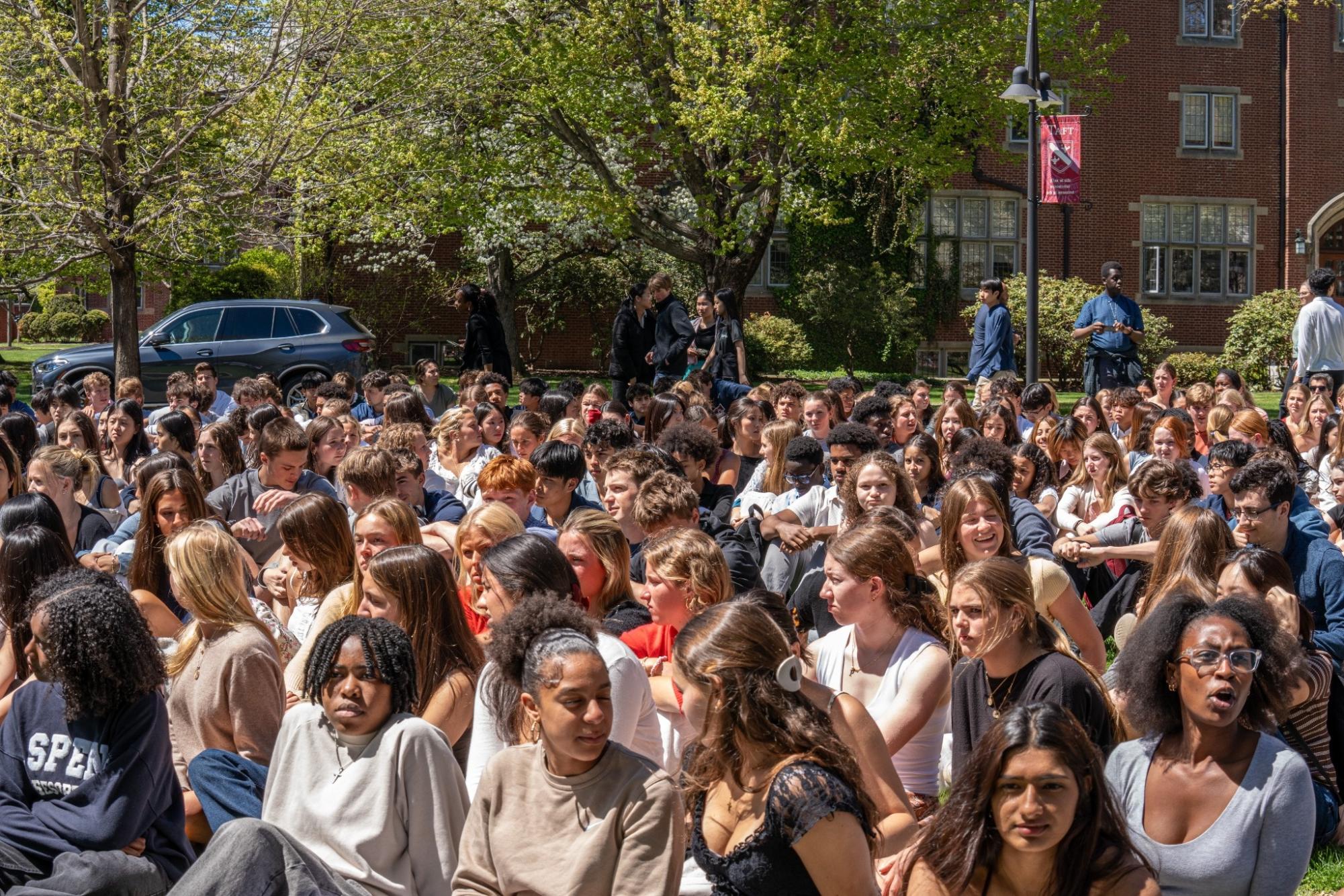
On Friday, April 24th, hundreds of Taft students, faculty, and board members participated in a walkout to protest the use of racial and homophobic slurs on campus. This followed an incident where two slurs were written on a faculty member’s office door, and many students, led by the affinity group heads, organized a response demanding action from the administration.
The first act put together by Mosaics was a meeting earlier that week on Monday to discuss initial reactions to the incident and to share ideas on how to move forward. Following that, Shades met on Wednesday for a similar conversation focused on processing feelings related to the event. Afterward, a joint meeting was held where the initial plans for the walkout were laid out as the group began to identify students they thought would be appropriate to speak at the walkout. As the aims of the affinity heads began to solidify, Kaylee Graham ‘26, Sarah Rochester ‘26, Jaiden Allen ‘27, and Crystal Alcantara ‘28 took the lead in organizing the walkout with the help of other Mosaic and Shades members. Shades and Mosaics’ diligent preparations took place behind the scenes during the last class week. The first public showing of the response was Friday morning, the day of the walkout, when the affinity heads placed signs around campus featuring anonymous stories from previous students of color at Taft who had been personally affected by racism in the community.
The posters served not just as powerful images, but as an objective calling out the harmful nature of Taft culture. As the posters were hung on Friday morning, students and the board of trustees, who had just arrived, stopped to read the shared anecdotes. Affinity heads also finalized their list of six demands for the administration in a meeting with the Gender and Sexuality Alliance (GSA) heads and the School Monitors. The demands are as follows:
1) We demand that the school start requiring ongoing training for all staff on how to handle bias, stop hate speech, and support every student.
2) We demand that the school prioritize regular, honest discussions that amplify diverse student voices and clearly define our community standards from the very start of the year.
3) We demand that the student handbook be updated to clearly ban hate speech, replacing informal warnings with documented, serious consequences like suspension or expulsion.
4) We demand that the school move beyond token gestures and commit to meaningful, student-involved programming for all cultural heritage months.
5) We demand the implementation of secure, anonymous reporting channels that guarantee students’ protection from retaliation.
6) We demand the immediate establishment of a student-faculty council to provide a structured, collaborative space for addressing equity, inclusion, and our overall school climate.
Similar to the meetings of Shades and Mosaics, GSA also held an open meeting on Monday night where many teachers, including Mr. Becker, were in attendance. They worked alongside the other affinity leaders to organize the walkout and the list of demands and, on Tuesday evening, wrote messages of affirmation and kindness across the campus.
For many students affected by these incidents, the pain comes from, yes, the acts themselves, but more so from seeing them occur in a community they still deeply care about. Estelle Magnan ‘27, a GSA head, similarly shared with the Papyrus: “I love Taft. I do. But sometimes it’s hard to love a place that keeps hurting you. Racism and homophobia have long been a part of the Taft culture, and it needs to end now.”
These acts, so plainly and intentionally done to harm a community or group of students, not only resonate throughout the culture of Taft but also affect the lives of individuals in their own reckoning with their identities. Vi Lapham ‘27, another GSA head, explained, “I’m a junior, and it took two years since I realized my own identity to feel comfortable enough to come out to my family and friends. My hesitation wasn’t random; it was shaped by the homophobic acts in this community that I experienced at Taft every year. Each lull between hate crimes abruptly ends in a shocking crash back to reality, reminding us how far we have to go. Part of being a ‘Taftie’ is having empathy to see beyond your own experience and consider someone else’s. Change is long overdue, and our frustration needs to be used to finally make a difference.”
One of the most frustrating aspects of the acts of violence is not simply their existence, but their recurring nature; it feels like each time the entire community has healed, another incident inflicts pain on those who already feel on the outside. Sarah Rochester ‘26, another affinity leader, outlined similar sentiments in her address with Maniah Williams ‘26 during the walkout: “As you’ve seen in the main hall, the list of incidents, and the lack of meaningful response from our administration speaks for itself. We are five weeks away from graduation, and we are standing here saying the same things that Seniors said to us when we were Lower Mids. Nothing has changed. That is the truth of our legacy.” Even so close to graduation, Sarah, Maniah, and many others still wish to bring forth change that they have yet to see during their years at Taft.
At the Papyrus, we unequivocally support the demands set forth by the affinity heads, particularly in institutional recognition of the harm the Taft community has caused, which has made students feel marginalized, hated, or overlooked. As the school newspaper, we feel the responsibility to help uplift these students’ voices in their fight for recognition and response from the administration, and for calling out issues as they are. Although the first step is acknowledging the history of racism and homophobia at Taft, and owning up to the fact that those actions do define who we are as a school and a community, there is still hope for the future. Despite the fact that the class of 2026 will be graduating in just a few weeks, it is never too late to change. Just as Eli Arroyo ‘26 ended his speech, “This is our moment to decide what Taft stands for: either the silence that protects the prejudiced, or the courage that protects the people. If we truly want to call ourselves a community, then let today be marked as a time we stopped excusing hate—and started demanding justice, accountability, and change.” Now is the time to make this moment matter, to make this moment the one where Taft chooses a new path to, yes, acknowledge its past, but more importantly, to finally change its future.
Photo courtesy of Steven Soares