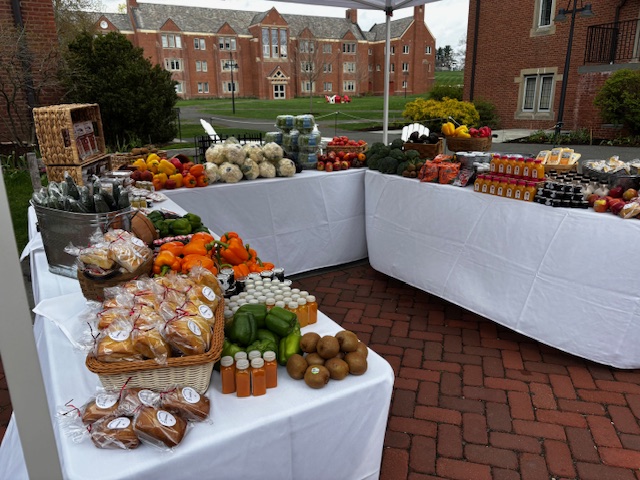


On April 20, as students, faculty, and staff headed to lunch, many found themselves automatically drawn to the line on Mac Quad for the annual Farmer’s Market. Tables were filled with fresh bread, local honey, cheeses, jams, ham, and produce, and people drifted from one to the next, facing the pleasant dilemma of having too many good options.
The Farmer’s Market, now in its second year, began as a simple idea: bring the community an experience of a local market without the barriers. At some other schools, similar events often require students to pay per item. At Taft, the goal was different. “We didn’t want students to have to pay for it,” Samantha, the Director of Dining Services at Taft, explained. “We wanted it to feel like a shared experience for the whole community.”
To make that possible, the dining team partnered with local producers, including a regional vendor, Sardilli, which connects them to hundreds of farms across the area. The widespread distribution of producers made possible an abundant, diverse selection of items. It has been observed that students generally gravitated towards easy, hand-held consumables — bread, yogurt, cheeses, maple syrup, honey, and pomegranate seeds disappeared quickly — while also getting a glimpse into the range of local agricultural businesses in the larger area.
Beyond the food itself, another goal of this event was to shift how we think about what we eat every day. For most of us, going to the dining hall is a routine repeated three times a day without much thought. We seldom slow down to notice where the food comes from or who prepared it. At the market, those same items were closely associated with their origins and producers.
This idea also carried into the Farm-to-Table dinner later that week. The dining team aimed not just to serve local food but also to represent where it came from. Nearly everything on the menu was sourced locally: beef from a farm just down the street in Watertown, vegetables from nearby producers, and bread from a local bakery. “We want students to understand that there’s a story behind what they’re eating,” Samantha said. In partnership with EcoMons, the team also hoped to encourage students to be more thoughtful about the origins of their meals and sustainability, and to appreciate the processes behind them.
The Farmer’s Market and Farm-to-Table dinner are only a part of the mindful system that operates Taft’s dining hall everyday. Behind each meal is a constant process of prediction and calculations. Using previous data, the dining hall adjusts food quantities and varieties, with estimations down to ounces per person. For example, food on Wednesdays and Saturdays will be different due to afternoon sports games. Production is scaled to feed the student body of around 580 as well as faculty and staff. “You try to get as close to the accurate number as possible,” Samantha explained, noting that while some level of waste is inevitable, the goal is always precision. The balance is one of the dining hall’s challenges: Too much food creates unnecessary waste, but too little food leaves people unsatisfied.
In regards to food waste, the dining hall has built extensive systems and solutions. Leftovers that are safe to reuse are donated, while other food waste is composted. For instance, the food student volunteers take to the St. Vincent DePaul homeless shelter are leftovers put to a good cause. These efforts reflect a broader effort to make dining effective and responsible.
Outside of large events, the dining hall continues to evolve. This spring, and into the next academic year, students can expect a range of new and returning events, from Friday night barbecues to chef spotlights featuring signature dishes and personal stories. There are also plans to expand more interactive initiatives, such as “Kitchen 101” sessions and student-chef competitions, which aim to bring students closer to the culinary process itself.
Ultimately, the dining hall is an ongoing collaboration between different communities. “This is their program,” Samantha emphasized, referring to students, “We want to do what they want to see.” The dining team actively encourages feedback and hopes that more students will take part in shaping future menus and events. Events like the Farmer’s Market stand out as highlights, but are a part of the everyday efforts of our dining team to make food thoughtful and engaging.
Photo courtesy of Taft Dining Services