This past April, Clint Smith, author of the #1 New York Times bestseller How the Word is Passed, visited Taft. In his talk, Smith spoke through three of the early chapters of his novel on Monticello, Angola Prison, and the Blandford Cemetery. As in his book, he explains not just the history behind the locations he visits, but also how people in the present interact with these sites, interviewing his tour guides, people he meets in the area, and the people on the tours with him.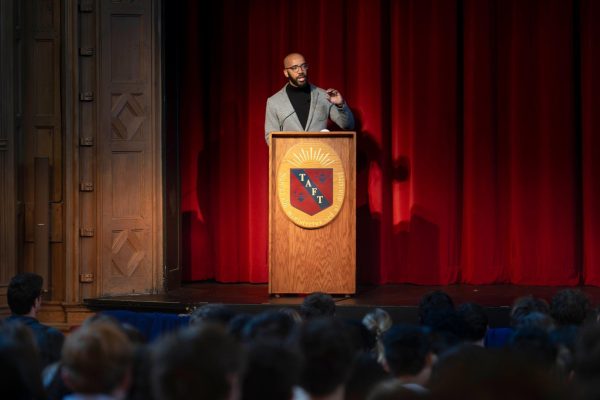
Something Smith said in his talk, which encapsulates part of why he is such an engaging author to read, is that he “doesn’t write [his] books from a place of expertise, [he] does it from a place of curiosity.” This approach to writing, unlike an academic journal or a Ph.D. thesis, makes his work both narratively engaging and approachable to the average reader. In one of the follow-up Q&A sessions, Smith expanded on his writing style by explaining that his work, for whom he was ‘writing for,’ was the sixteen-year-old version of himself; he wanted to paint a picture that revealed the messy and complex nature of American history through the stories of real people and a narrative journey you go on with the author as he too learns more about the past. “My life as a writer,” Smith said during the Q&A, “is predicated on my curiosity.” Echoing the sentiments in his speech, Smith expanded on the necessity of creativity in your profession, which absolutely comes to the forefront in his writing as he explores these locations with the reader.

If you know me, you may know I love history, but what you may not know is just how great an impact Smith’s writing had on that love. I picked up How the Word is Passed during Spring Break of my Junior year. Before reading Smith’s book, I would have never considered myself to be a nonfiction reader, and if I’m being honest, I thought all nonfiction was either self-help or workplace management books, neither of which appeals to me. Nevertheless, despite my bias against a very broad genre of writing, I found myself interested in what Smith had to say.
The book found me at the right time, as well. I was three-quarters through the year of U.S. History and, for the first time, seriously considering what I liked and wanted to study in the future. This idea of reckoning with our history, which runs as a constant thread throughout the book, really stood out to me as something I wasn’t accustomed to; Smith’s aim was to complicate the narratives most of us have grown up knowing and never challenged, and that core of learning, discovering, and disrupting history is what I loved most about it. He ends his book (Spoilers!) by concluding that “at some point it is no longer a question of whether we can learn this history but whether we have the collective will to reckon with it.”
If his work or his speech seemed at all interesting, I urge you to read Smith’s full book; How the Word is Passed will not disappoint. Take this as a sign, even if you loathe history, that branching out to try something entirely new might be worth it. As Smith said in his speech, the only way to change these narratives and ingrained loyalties to previous beliefs is to branch out and to ask questions that force people, and ourselves, to confront our own moral inconsistencies and learn to reconcile our own history.
Photos courtesy of The Taft School and Goodreads