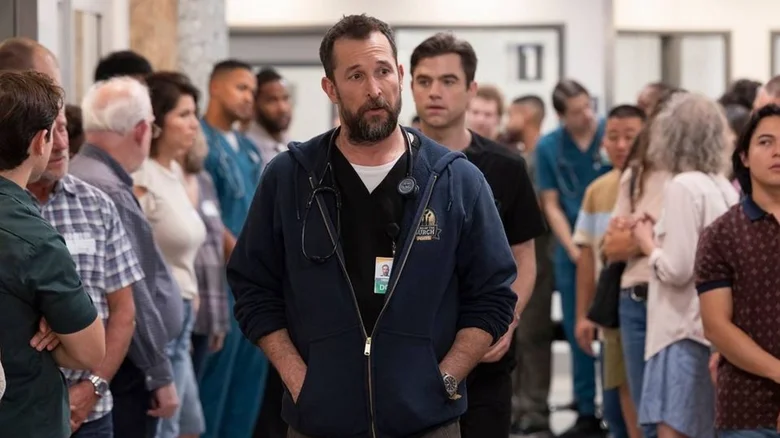

In honor of the tantalizingly slow release of Season 2 of the medical drama to end all medical dramas, I would like to make a case for why The Pitt is novel, brilliant, and worth a watch (and maybe a fixation). Each episode in this gripping series represents one hour in the emergency room of the fictional Pittsburgh Trauma Medical Center, and each ends with a cliffhanger that seeps into those minutes you spend zoning out in class. I’ll admit that I speak from experience.
One reason The Pitt is so engrossing is that it is unrelenting in its emotions. The characters experience real problems presented with a moderate approach that falls between melodramatic and sterile or mathematical. The characters never retreat into the cafeteria to gossip, nor are they filmed revealing their backstories in their own apartments. Instead, they drop hints about their personal lives and dynamics with others in short one-liners that make the viewer feel like they’re eavesdropping on their coworkers. The show also doesn’t shy from political or social commentary, naturally incorporating topics like addiction, immigration, and mental illness, all of which affect this group of emergency doctors and nurses who empathize with their patients’ problems and try to suppress their own in the professional environment.
The Pitt thus humanizes medicine: it argues that health professionals are neither paragons of virtue nor miracle workers, though we would frequently like to view them as such. The show’s protagonist, Dr. Rabinovitch (played by Noah Wyle, who was previously the star of ER), represents the harm that the pressure of romanticizing and blaming doctors can do. Many earlier dramas portray doctors as either always right or always composed, and The Pitt dismantles this idealism from as early as the very first scene.
Let’s compare The Pitt to a predecessor show like Grey’s Anatomy. One of the most frustrating things about the latter to me was always its reliance on the unrealistic for effect. In one episode, doctors determine that a woman has a recessive gene fatal to her children. They proceed to print out the healthy human genome as a sequence of letters, and then the entire genome of the woman, and demand that all doctors drop their cases and begin manually circling in pen the mutations to find the malignant one. In the age of computers, any layman could tell you that this is not how it’s done. This scene is at best silly and at worst a slight insult to the intelligence of the viewer. Grey’s is clearly committed to dramatization – an artistic liberty – but is this excessive?
Meanwhile, The Pitt recognizes that real medicine is intrinsically dramatic and exciting or tragically capricious, and does not feel the need to invent scenarios like paper DNA. Sure, sometimes the chaos of the ER is exaggerated, but this is in the interest of enhancing the humanity of the doctors; it is not a scientific inaccuracy. I think the most satisfying part of its appeal is that it feels incredibly scientific and mechanistic, and thereby flatters the viewer’s ego when they begin to recognize and remember medical terms. Because of this, the show is simultaneously technical and accessible, an impressive dichotomy for the writers to achieve.
I could write about this show for pages, but I think it’s enough for me to just say I could. Go watch it for yourself!