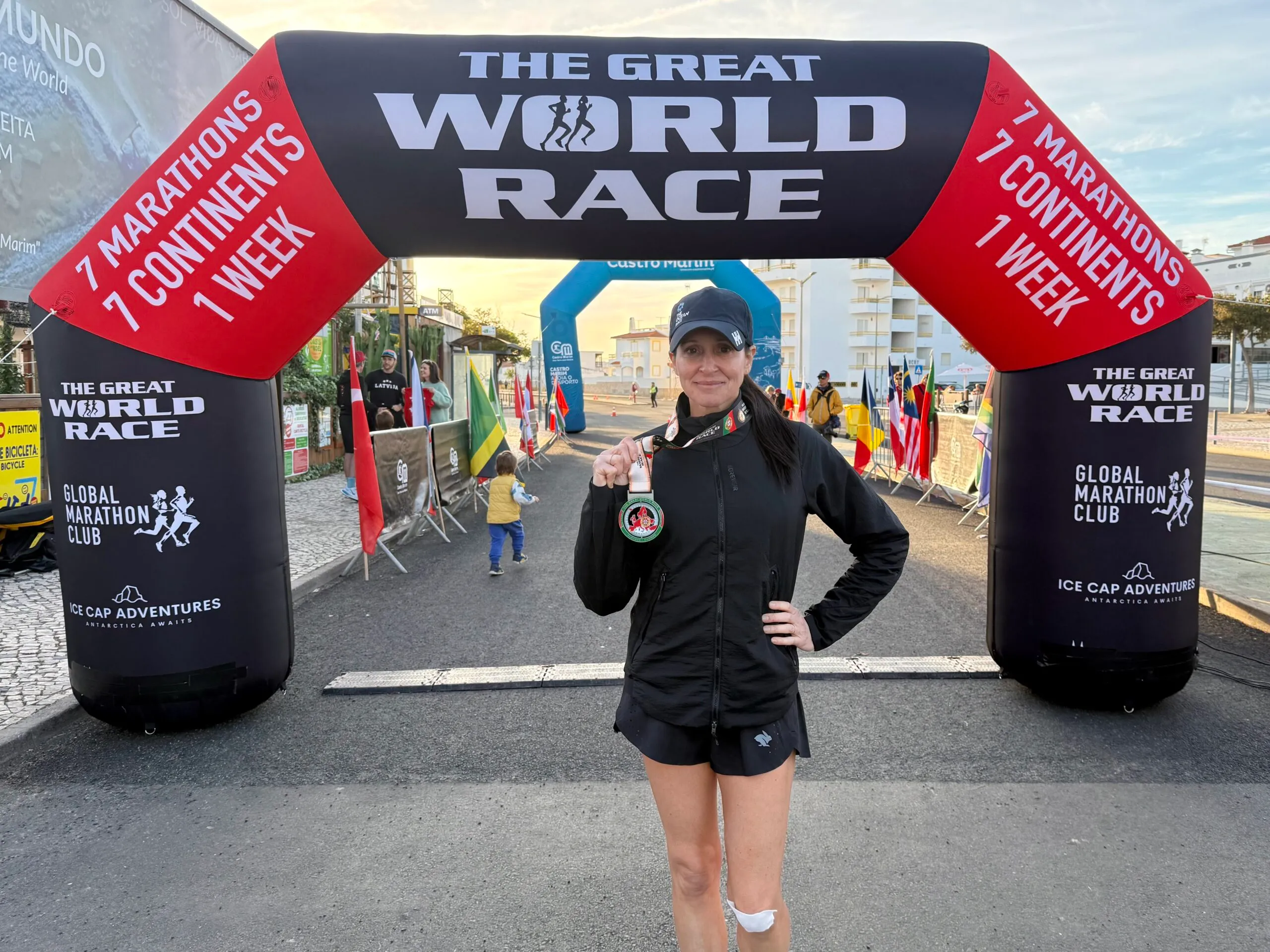

When Jenny Rowe missed her sub-3:30 marathon goal in Rome by 45 seconds, she didn’t recalibrate her expectations. She booked another race, this time in Cleveland, Ohio, and ran until those 45 seconds disappeared.
It’s a small detail from her speech in Bingham Auditorium during her Morning Meeting address on February 17th, but it is a glimpse into a mindset that has carried her throughout countless races around the world and through the most challenging chapters of her life.
That instinct has carried her through ten marathons across four continents — from the Arc de Triomphe finish line in Paris, where she ran her first in 2014, to the blinding Arctic blizzard in Tromsø, Norway, where she spent the final 10K with ice and snow driving into her eyes. It carried her through an ACL tear that pulled her away from running entirely, forcing her to rebuild not just physical strength but the daily discipline of routine. And now, it’s carrying her into something far more exposed than any race: a documentary centered on her brother’s death from addiction.
In a follow-up interview after her speech, Rowe was candid about the tension this project creates within her own family. “A lot of people, my family, are not excited about this project,” she said. “But for me, the chance to help other people gives meaning to my brother’s life.” Her brother — 14 years younger, extraordinarily brilliant, once working toward a career prosecuting war criminals at The Hague — died after struggling with addiction in silence.
The anger Rowe still carries isn’t abstract. It’s specific: why didn’t he ask for help?
That question has reshaped what running means to her. What began as a personal hobby has become a way for her to pursue a larger mission — her upcoming 777 challenge (seven marathons on seven continents in seven days) will serve as the backbone of a documentary aimed at destigmatizing addiction. She’s not running to prove she’s extraordinary.
“I made the JV lacrosse team. I wasn’t on the varsity,” she says. She walked on to her college sailing team. There is, she insists, nothing physically remarkable about her. The point is precisely the opposite — that ordinary people are capable of extraordinary endurance, and that the barrier is almost never physical. “Overwhelmingly, your mental state is what gets you there.”
This message particularly resonated at Taft, a community Rowe admires but also sees clearly. When asked about burnout and depression among high-achieving students, she recognized the same pattern from her own life: years spent in a finance career that met external expectations but never felt like her own.
“Relying on external validation and that being the sole motivator for what you do — it really is quite empty,” she reflected. Finding internal motivation, she added, is “a lifelong process.”
As she reflected on the motivations and stories that have stayed with her, one thread kept on resurfacing: her deep connection to the stories of polar explorers from the 18th and 19th centuries. These explorers ventured into uncharted territory, often at the cost of their lives, driven by something they couldn’t fully explain.
She listens to their accounts during training runs, and she sees in their compulsion to return to the ice something fundamental about human nature: the refusal to accept that we’ve reached our limit.
It’s that same restlessness that brought Rowe to Bingham Auditorium. And while she’s already deep in training for her next 777, the project she kept circling back to was the documentary: the conversations she hopes it opens, the chance that someone struggling with addiction sees her brother’s story and feels less alone in asking for help.
“If it changes one person’s story,” she said, “whether it’s tomorrow or 20 years from now — it’s all worth it.”
Photo courtesy of Jenny Rowe