
On April 1st, the first crewed mission beyond low Earth orbit since Apollo 17 in December 1972, took flight. The Artemis II set out to make history in a lunar flyby that would be the furthest distance ever traveled from Earth. Besides breaking numerous space-travel records, the mission is a stepping stone in NASA’s development of deep space exploration, ultimately reaching towards the goal of landing on Mars.
The crew is traveling in an Orion spacecraft, a cornerstone of the Artemis program, designed to carry four astronauts to the moon and back. The ship, as a part of its development for deep space exploration, features advanced life support systems, increased radiation protection, and a heat shield intended to withstand high-speed lunar returns. The ship is equipped for a 21-day journey, but the mission is scheduled to be completed in 10 days. When reconfigured, the ship is designed for trips potentially as long as 1000 days, laying groundwork for space missions further than humans have ever traveled previously.

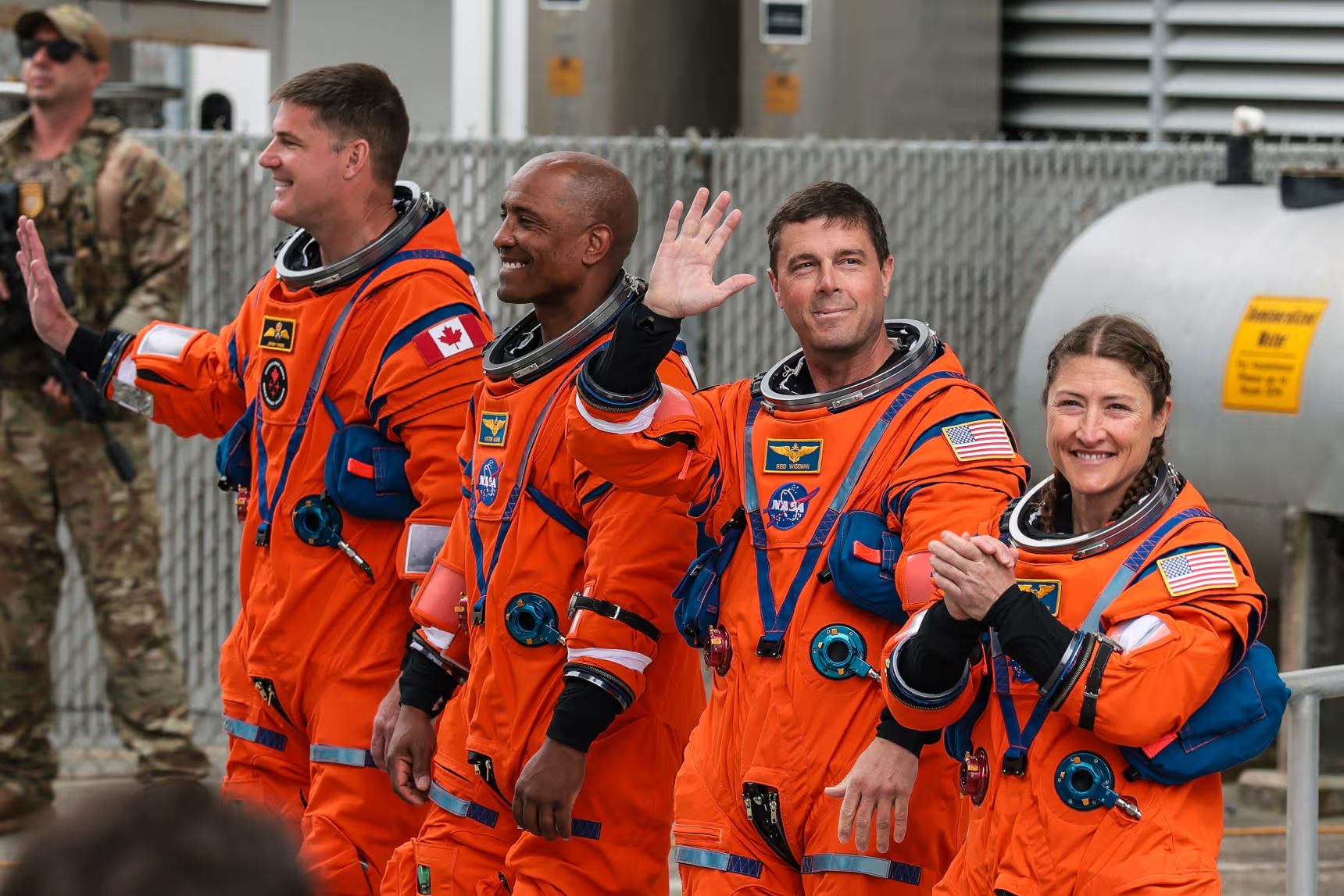
On the actual mission are four astronauts: Reid Wiseman, Victor Glover, Christina Koch, and Jeremy Hansen; this crew, like the spaceship, is pushing boundaries and setting records in space travel.
Reid Wiseman became an astronaut in 2009 and is currently serving as the commander on the Artemis II mission. Before flying on the Artemis mission, Wiseman served in the U.S. Navy for 27 years, then in 2014, spent 165 days on the International Space Station, where he completed over 300 scientific experiments. His work pertained to human physiology, medicine, physical science, Earth science, and astrophysics. At home, in Baltimore, Wiseman maintains the belief that the greatest challenge and the most rewarding phase of his life was raising his children as a single parent. Artemis II marks Wiseman’s second space flight, and as commander, he will lead the team in operations and mission execution on their 10-day journey.
Victor Glover was first selected as an astronaut in 2013 while serving as a Legislative Fellow in the United States Senate. He most recently served as pilot of the Crew-1 Dragon spacecraft, named Resilience, which flew to the International Space Station, where he also served as a Flight Engineer. On Artemis II, Glover will serve as pilot of the ship; he began flying in 2001 and reported to the Marine Fleet Replacement Squadron in 2002, followed by the Blue Blasters of Strike Fighter Squadron in 2003. During his service, Glover completed his final deployment on the U.S.S. John F. Kennedy in support of Operation Iraqi Freedom. Like Wiseman, Artemis II will be Glover’s second space mission, the result of thousands of flight hours and over two decades of training.
Christina Koch is an explorer and engineer who became an astronaut in 2013. She has been assigned as a mission specialist for the Artemis II mission. In 2019, Koch lived and worked on the International Space Station for almost the entire year during Expeditions 59, 60, and 61. For this mission, she flew on the Russian Soyuz rocket and trained extensively in Russia. During her mission, she spent 328 consecutive days in space and participated in the first all-female spacewalks. On Artemis II, Koch will serve as one of two mission specialists; in her role, she will serve as an onboard engineer and systems expert, responsible for conducting intensive tests on the Orion spacecraft, managing experiments, and performing manual piloting demonstrations. Integral to the mission, Koch’s more than two decades of experience working with NASA have prepared her for this landmark space journey.
Last, but certainly not least, Jeremy Hansen is the fourth member of the Artemis II crew, serving, like Koch, as a mission specialist. Hansen, unlike the other members of the crew, is a Canadian, making him the first Canadian assigned to a lunar mission. Hansen began his training in air travel at age 12 when he enrolled in the Royal Canadian Air Cadet Squadron in London, Ontario; he was later selected as a recruit by the Canadian Space Agency in 2009, then became affiliated with NASA in 2017. Artemis II will be Hansen’s first journey into space, where he, alongside the three other astronauts, will make history on their lunar mission.
There have been no lunar missions since 1972, yet Artemis II dared to push the envelope in terms of long-term goals of space exploration and travel. On April 6th, Artemis II made history by breaking the record for furthest human distance traveled from Earth, reaching over 252,760 miles from home. Despite Artemis II already breaking records and treading new paths in terms of space exploration, it seems the Artemis missions are far from over, with NASA’s desire to explore further than ever before. Artemis marks a fundamental shift in space travel, redefining the limits of human exploration and extending humanity’s reach to bounds not previously known, helping to set the stage for a future where human travel to Mars could become a reality.
Photos courtesy of NASA