“Wait, they’re not blue, they’re indigo!” It’s a familiar scene: a fellow student insisting to a faculty member that their blue jeans are in fact just black or purple with a blue-ish tint. These debates seem silly, but they reflect a larger reality: At Taft, that distinction matters. Our student handbook explicitly prohibits “any kind of clothing made of blue denim” to class. But what exactly is wrong with blue denim?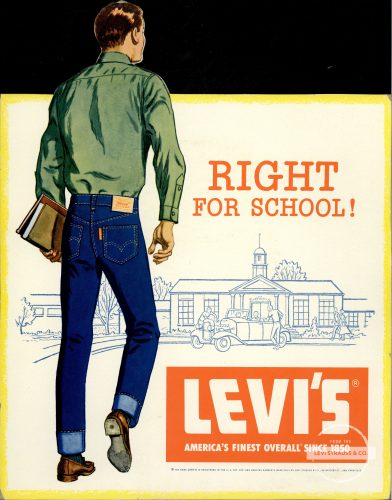
The answer lies in its history. First invented in the early 1870s, blue denim’s durable texture accommodated miners, farmers, and cowboys; hence its association with “blue collar” workers. Decades later, in the 1950s films “The Wild One” and “Rebel Without a Cause,” James Dean and Marlon Brando play rebellious teenagers wearing blue jeans and riding motorcycles. As a result, blue denim jeans became a symbol of teenage rebellion.
Around the same time, blue jeans also represented political rebellion. Protesters for racial justice and gender equality wore blue denim as a uniform. In an effort to disassociate their students from the rebellious blue jeans, schools across the country began banning them in the 1950s. In response, Levi’s, the company that invented blue jeans, created the “Right for School” campaign, demanding that blue jeans were appropriate in classrooms.
Blue denim’s reputation continues to evolve today. Nowadays, it is a versatile fashion staple for everyone. However, whether or not it belongs in a professional space is still contested. Some believe that blue denim is no longer as informal as it once was and should now be allowed in workspaces and schools, while others do not agree. But for Ms. Leal, what’s most important is that students show up for class dressed in a way that signals, to themselves and others, their readiness to learn. If the goal is simply to put in effort into our appearance, it is fair to question whether wearing blue denim really matters. Students can certainly dress neatly and seriously with blue jeans on.
Still, perception matters. As Mr. LaCasse points out, people on average still wear blue jeans on more casual occasions. And while the presence of blue jeans may not necessarily affect our quality of education, Taft strives to follow the general standards of a professional environment to prepare students for life after high school. However, these standards have never been fixed. Tracing back to Taft’s founding in 1890, our all-male student body was required to wear blazers and ties to class every day. Clearly, our dress code has made dramatic changes since then.
Another explanation for the ban’s lasting existence could simply be inertia. As Mr. Parente explained, school administrators are often focused on more urgent concerns such as students’ health and safety. Therefore, dress code changes are rarely a priority. Furthermore, anytime a change is made in school policy, it requires careful thought and deliberation, which means change takes time. So while the ban on blue denim may have once been intentional, it seems less like a deliberate stance and more like an overlooked policy today.
So, where do we go from here? In conversations with Mr. LaCasse, Ms. Leal, and Mr. Parente, two questions repeatedly came up. First, how should Taft adapt to changes in society’s fashion expectations? While blue jeans were once completely unacceptable in professional settings, that might no longer be the case. But especially with the rise of fast fashion, trends are constantly changing at a rapid pace. How and when should our school policy respond to and reflect these changes?
Second, how should Taft balance professionalism and self-expression? On one extreme, we all wear school uniforms. On the other extreme, we get rid of the dress code. We do not want either option. So, how should Taft’s dress code navigate the grey area between these two? How do we maintain proper dress without being too restrictive?
Though the answers to these two questions might be muddy, one thing is clear: our school leaders are continually reviewing school policies and doing so with students’ best interests at heart. Mr. Parente emphasizes that they are always balancing between understanding students and keeping them accountable to do what’s best for their development. Deciding what the “right” policy is is not an easy job. With blue jeans in particular, there is a wide spectrum of perspectives among students and faculty. But given the overall shift in their reputation, it may be time to reconsider whether the blue denim ban still serves its original purpose.
Photo courtesy of Levi’s