


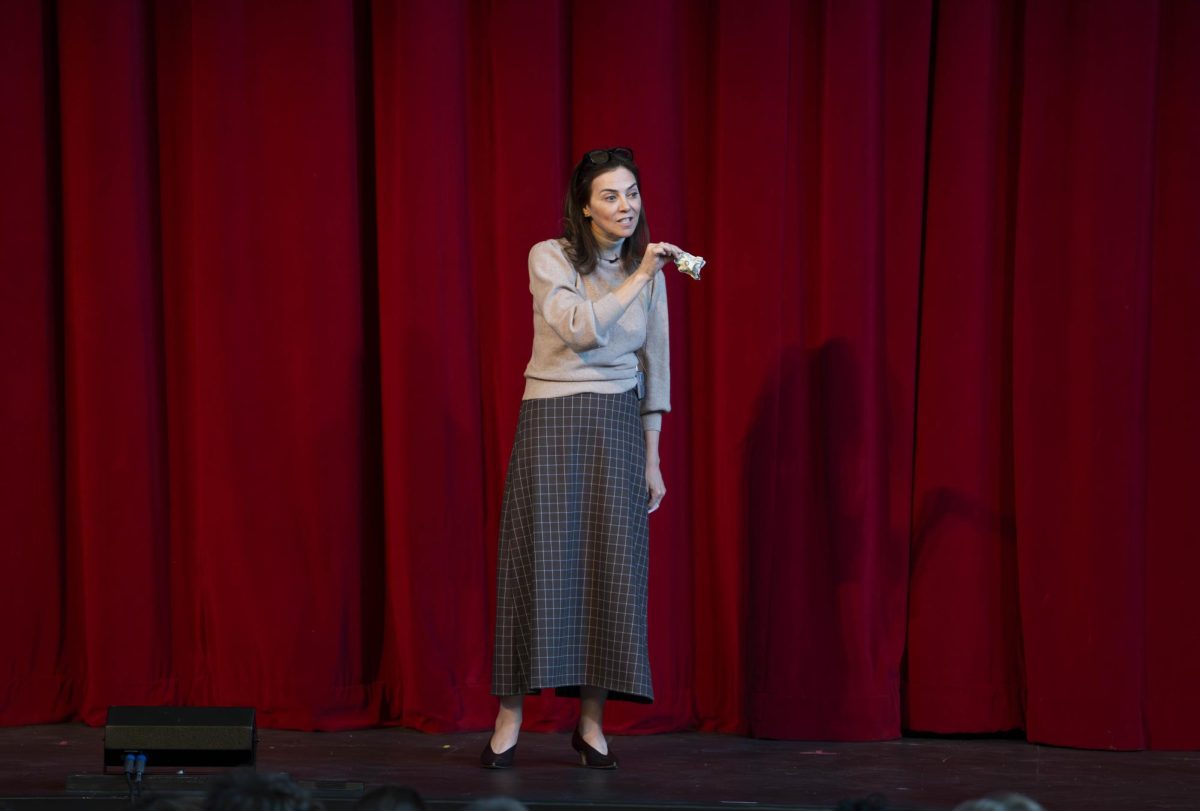


A few weeks ago, I overheard students buzzing about how Dr. Mirabi had just solved a problem that had been open for 47 years, and that he would soon be speaking at Harvard over Family Weekend. As a former student who once struggled through his class (but loved every bewildering minute of it), I wanted to congratulate him in person. More than that, I was curious: what sort of problem resists some of the world’s sharpest minds for nearly half a century?
It had been almost a year since I last interviewed him for a Papyrus article, and this felt like the perfect chance to speak with him again (he might be the busiest man on campus). Only then did I realize that his Harvard talk and the 47-year-old problem were regarding two completely separate achievements. His lecture focused on sunflowerable structures; the breakthrough concerned the zero-one law. And then he both casually and humbly mentioned that he had just received the Christine Ladd-Franklin Logic Prize for his paper on “Forcing with Invariant Measures.”
The 47-Year-Old Puzzle
To explain the zero-one law, he offered an analogy: imagine building a giant network by flipping a coin for every possible connection. As the network grows, certain statements about it become almost always true or almost always false. That predictability is called the zero-one law.
Decades ago, mathematicians wondered what would happen if we strengthened the language used to describe these networks, just enough to compare the sizes of two sets. “Once your logic can compare sizes,” Dr. Mirabi said, “it becomes strong enough to express arithmetic.” And with that, some patterns stop settling into clear behavior. This matters beyond math: this rule helps social media platforms and marketing teams to decide things like who sees which ad. The zero-one law helps show when patterns are predictable, and when they aren’t.
Dr. Mirabi first encountered the question in 2017. He would set it aside, then rediscover a detail that pulled him back. “Maybe this problem just doesn’t want to be solved,” he remembered thinking. But every so often, a small observation was enough to keep going.
The Turning Point & The Mindset
When the turning point finally arrived, it wasn’t necessarily cinematic. Late at night, as he revisited an argument, he noticed that two ideas fit together. He messaged his colleagues, expecting them to find a flaw. Instead, they responded with excitement and refinements. “In a way,” he said, “the real ‘aha’ moment was seeing how our individual insights finally converged into one clear picture.”
Thinking about my own habit of contemplating retirement over one homework problem, I asked whether he ever felt tempted to give up. “Many times,” he laughed, but he has “grown more comfortable with the idea that not knowing is productive.” His work becomes less about defending certainty and more about staying curious long enough to find new clues.
That philosophy spills naturally into his teaching. Teenagers, he pointed out, have a fearless way of asking “why?” They refuse complicated technical language; they force clarity. Each time he explains an idea simply, he understands it better himself. Students who haven’t been weighed down by too much background knowledge are more willing to explore unconventional paths, reminding him that mathematical creativity isn’t about knowing everything, but staying bold enough to explore.
Beyond the Classroom
Outside of math, he watches and plays soccer, practices amateur photography, and tells bedtime stories in an ongoing saga titled Javad and the Wonderland, in which his son is the hero and he plays the perpetually confused companion. While working, he listens to film soundtracks — “they make proofs feel cinematic.” I tried this right after our conversation, doing my math homework to the Mission Impossible theme (it works!). There’s usually Persian tea scented with cardamom at his elbow, plus pistachios for especially tough problems.
I was amused to learn that we share something else: he also enjoys doing “absolutely nothing” when he can, wandering corners of the Internet or staring out the window. “Those moments,” he admitted, “are as rare as a simple proof.”
When I asked for advice for students facing their own blank pages, his answer was simple: “Find meaning in what you do. That’s where real energy comes from.” Balance matters too: sleep when you can, laugh when you can’t, and make space for something you genuinely love. “Tea,” he noted, “solves about 43.7 percent of life’s problems.”
Looking ahead, he’s exploring new connections between logic and combinatorics and developing upper-level math courses at Taft to bring students closer to the questions he finds most exciting. We ended our conversation as he packed up to pick up his son, leaving his next idea waiting patiently in his notebook.