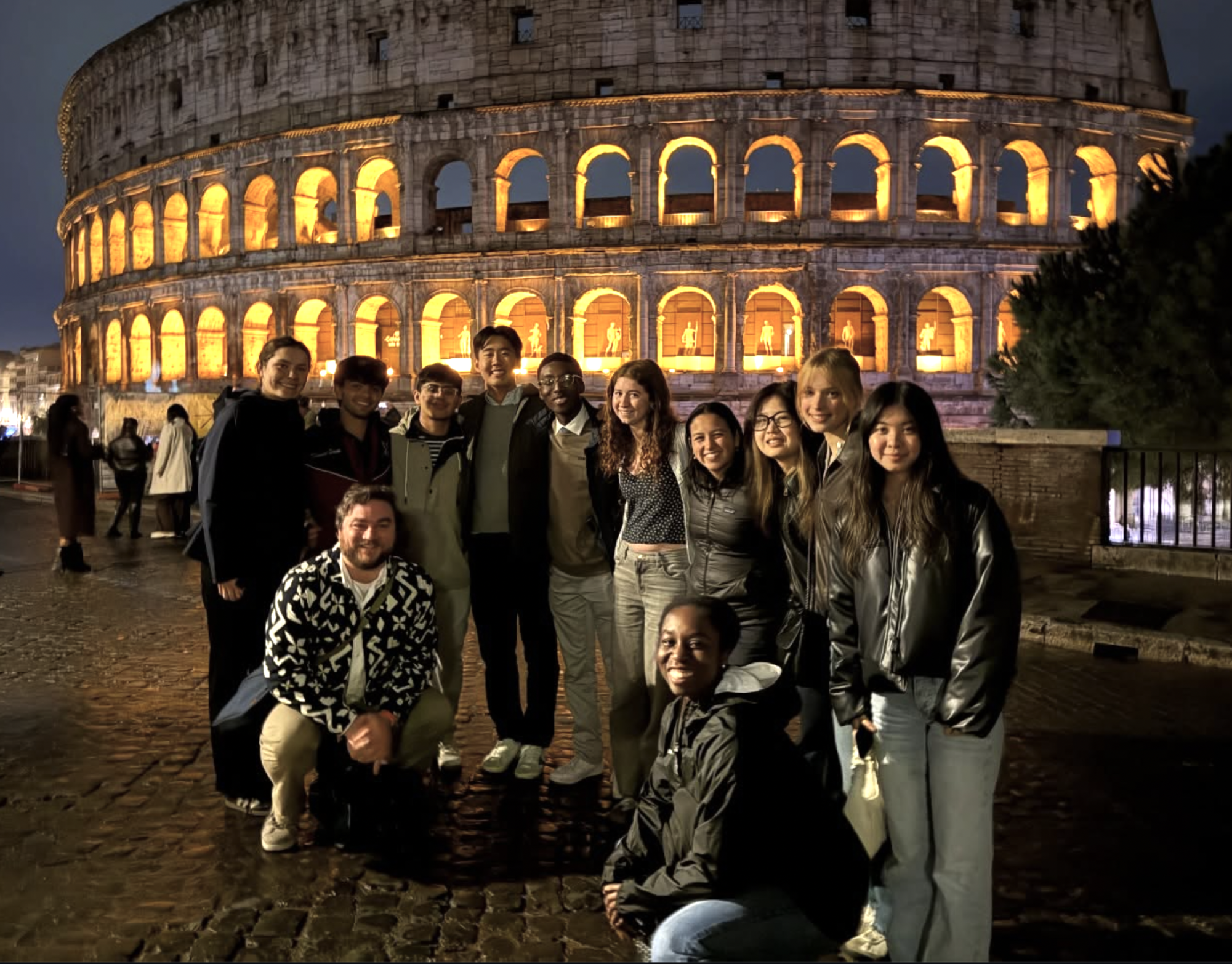


This spring break, ten students in Honors History of Western Art traveled to Italy, including four writers on The Papyrus: Allison Palmer, Steven Zhang, Louisa Prentice, and Aarav Seth. During our trip, we traveled through Italy, primarily Rome and Florence, with day trips to Siena and Padua, working our way through many churches, museums, and other historic sites (with lots of delicious Italian food as well).
Although this mix of seniors and juniors had the opportunity to travel this spring, taking a trip this extensive took several years of planning and preparation. When designing the trip, Mr. Werrell explained that “there is nothing in the classroom that can approach what it feels like to stand in front of a painting, the thing itself: to understand its size, to see the way the work catches the light and how it converses with the surrounding works, to find traces of the artist’s hand, even.” The detailed trip complemented the work we had been doing in class previously, studying the Italian Renaissance and Counter-Reformation. Works we had only ever seen through a computer screen were before our very eyes, giving life to the many masterpieces we had studied in the classroom.
We arrived in Rome on March 9th, jet-lagged but eager to explore the new country, as we immediately stopped at our first church of the trip, Basilica di San Giovanni in Laterano (the first of twelve!). In addition to the ten art historians, Mr. Werrell, and Ms. Obeng, we were accompanied by Jon Bouillot, perhaps one of the most well-versed and knowledgeable historians in Italian art; his fashionable scarves and peacoats definitely added to his swagger.
Other notable churches we visited were the Basilica of St. Peter in Chains, where we were able to study Michelangelo’s famous sculpture of Moses, surrounded by sculptures of Rachel and Leah, whose physical positioning reflected their given personalities and actions in the Bible. On our third day, we visited Santa Maria della Vittoria; its exceedingly baroque design houses one of Bernini’s masterpieces: the Ecstasy of Saint Teresa. This sculpture depicts the moment when Santa Teresa is visited by Christ, illustrating the passionate emotions associated with the encounter. Most memorably, above the statue, it reads, “If I had not already made heaven, I would make it for you.” Being able to see the expert nature in which Bernini was able to carve such a distinct combination of devotion and ecstasy was truly incredible and set the bar high for the coming days.
On our first d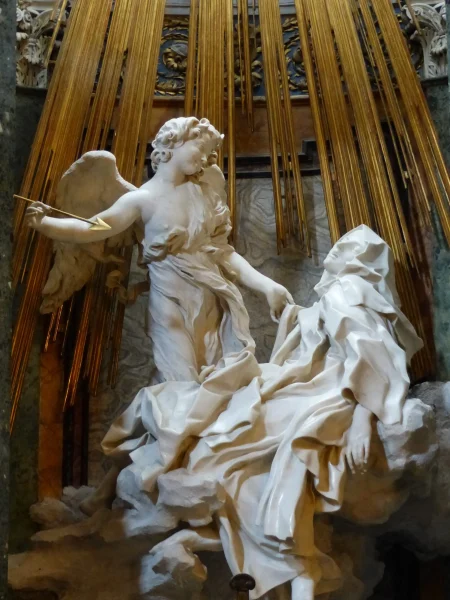 ay trip, to Siena, Italy, we stopped at the Duomo of Siena (not to be confused with the Duomo in Florence). Its huge striped marble columns emphasize the enormity of the building, with intricate mosaic images lining the floor. From head to toe, the Duomo of Siena, littered with pointed arches, embodies a Gothic style to its fullest extent. On our second day trip, we journeyed from Florence to Padua, Italy, to visit the Scrovegni Chapel, which we had previously studied extensively in class. Inside the Chapel, frescoes by Giotto line the walls, telling the story of the Gospel from Mary’s birth to the Resurrection and Last Judgment. Despite our limited time inside the chapel, we were able to see connections across frescoes that aligned vertically and horizontally, which would otherwise have been impossible.
When we weren’t church-hopping throughout Italy, we could almost certainly be found in a museum, examining works from Duccio, Botticelli, Carravagio, or Leonardo. In Rome, we spent illuminating hours in Villa Farnesina, Villa Borghese, and the Capitoline Museums, each offering a different lens into Baroque and Renaissance art. At the Capitoline Museums, we examined sculptures by Lorenzo Bernini, notably the marble bust of Medusa, and even spent time admiring the architecture of the building itself, including Michelangelo’s staircase. After traveling to Florence, we went to the Uffizi Gallery, where we saw works like Botticelli’s avvaav and The Birth of Venus, along with numerous paintings by Leonardo, Cranach the Elder, and Raphael. From the Uffizi’s terrace, we looked out over Florence’s skyline, taking in the iconic Duomo. We also visited the Accademia Gallery, where we saw Michelangelo’s remarkable David in person, its scale and detail far surpassing any image we had studied in class.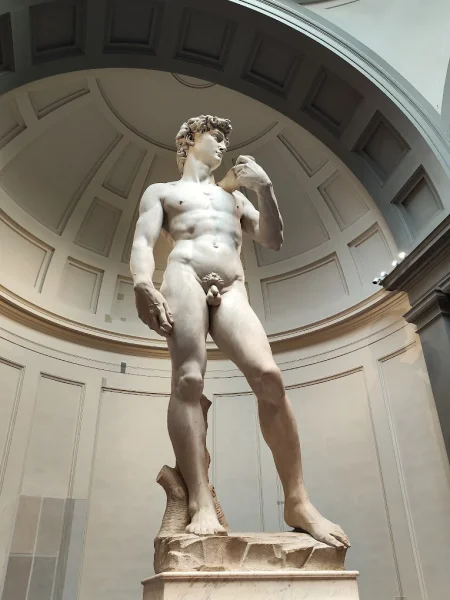
Our packed schedule also included visits to other historical sites (some now museums), such as the Palazzo Publico in Siena. In the Palazzo, which, fun fact, is the structure the Waterbury train station is modeled after, there were rooms upon rooms of frescos painted by Lorenzetti. Most famously, on two walls facing one another is the allegory of good and bad government. These two opposing frescoes served as a reminder to leaders of the time of the important qualities needed in a ruler and of the threat that tyranny posed. While in Rome, on our first and third days, we visited locations central to the English poet John Keats. We began by visiting his grave in Cimitero Acattolico, where he lies beside his dear friend Joseph Severn. At the Keats-Shelley House, we were able to see where Keats spent his last days, dying
of tuberculosis, alongside Joseph Severn, who cared for him in his final days. When reflecting on Keats’ life, we read one of his most famous
poems, “Ode on a Grecian Urn,” in which Keats ends by writing “‘Beauty is truth, truth beauty,’—that is all / Ye know on earth, and all ye need to know.” His work tied into our other lessons by expressing the idea that appreciating art is more than mere observation and is integral to shaping how we see beauty and truth. Like the urn, many of the altarpieces we observed transcended time through their use of gold, and even the city of Rome itself, itself from another era, remains.
Although the bulk of our trip was spent looking at myriad works of art, we also had the opportunity to experience Italian culture, including lots of delicious food, evening walks, and shopping. Each day for lunch, we got to explore the neighborhood we were in that day and find a restaurant there. For dinner, we had reservations each night at a wide variety of locations and experiences, from charming handmade pasta and pizzas to opera-singing waiters, we got to experience it all! In our 10 days abroad, we, like Julius Caesar, came, saw, and conquered all that Italy had to offer.
Photo courtesy of Mr. Werrell