









American hockey star Jack Hughes, who has been selected to represent Team USA at the upcoming Milano-Cortina 2026 Winter Olympic Games, recently described what it’s like to be a part of the United States men’s group searching for its first gold medal since 1980. That American victory, famously known as the “Miracle on Ice,” featured a U.S. team made up of college players defeating a seemingly unstoppable Soviet Union Red Army team.
“I mean, if you’re a hockey player in the U.S., you grew up watching [the] ‘Miracle on Ice’ [team], and that’s like the biggest USA memory,” Hughes told NBC’s Today Show. “And you know, every hockey player wants to grow up and play in the NHL, but I think the biggest dream is playing in the Olympics.”
Next month, Hughes and the world’s other best hockey players will gather in Milan, Italy, and begin games on February 11. Donning the jerseys of their national teams, even athletes who play together in the NHL will set aside their friendships for two weeks of epic battles. Childhood dreams, national pride, and maybe even some geopolitics will be at stake. For American players like Hughes, ending a forty-five-year gold medal drought will be a top priority, but so will defeating Canada: a rival as formidable as the once-dominant Red Army team.
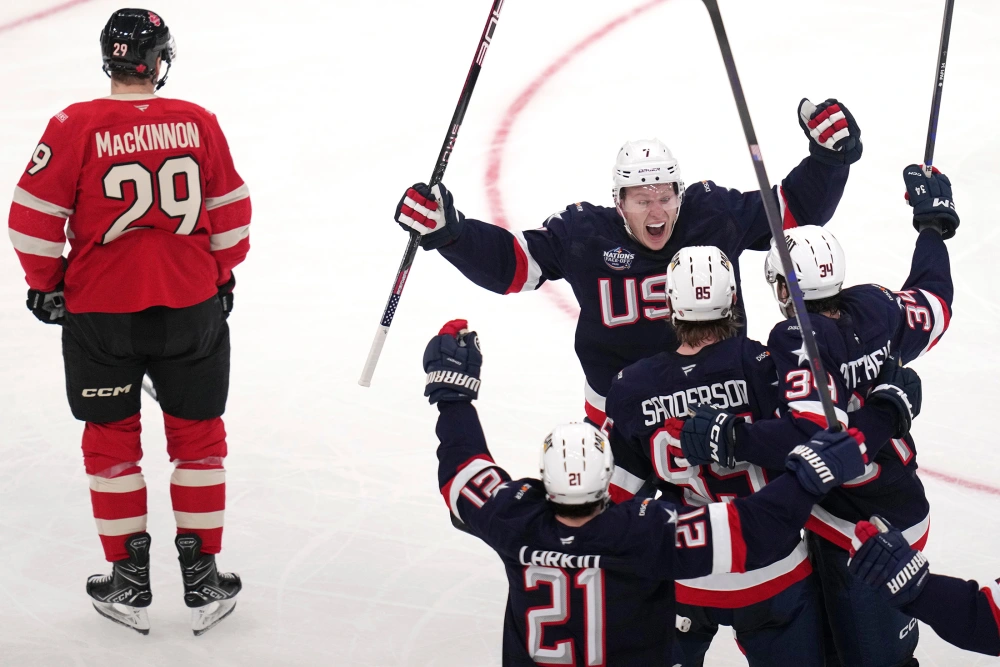
To understand the level of anticipation for a Team USA vs. Team Canada showdown in Italy, one must go back to the last time these two rivals clashed in February at the 2025 Four Nations Face-Off. At that time, fans across North America stopped everything to watch two monumental confrontations between some of the sport’s biggest stars.
The first encounter was a preliminary-round game in Montreal, in front of a crowd that booed the American national anthem. Perhaps, in part, due to President Trump’s tariff war with Canada and his threats to annex the country as the 51st state, or perhaps simply due to intense rivalry. Within seconds of the first puck drop, multiple fights broke out on the ice, and, in the end, the USA captured a 3-1 victory. However, just days later, the two teams met again in the championship, and Canada came away with the 3-2 overtime win.
For hockey fans and players alike, the Four Nations Tournament was seen as the precursor to the more meaningful 2026 Winter Games, which include a total of 12 men’s teams. Players are particularly motivated heading into Milan, as this is the first Winter Olympics since 2014 in Sochi, when the NHL allowed its stars to compete.
With just a few short weeks until the Games begin, rosters have been finalized and brackets set. Group A will consist of Canada, Czechia, Switzerland, and France. Group B will hold Finland, Sweden, Slovakia, and Italy. Finally, Group C will contain the USA, Germany, Latvia, and Denmark. With the USA and Canada in different groups, fans will have to wait patiently until after the preliminary round for a showdown.
Entering the Games, Canada, the USA, and Sweden are all heavily favored to compete for gold, with Canada having the edge. It boasts a team that has an incredible balance of young and experienced NHL superstars. The Avalanche’s Nathan MacKinnon, the Penguins’ Sidney Crosby, and the Oilers’ Connor McDavid will lead them at the forward position, with Colorado’s Cale Makar as the team’s top defenseman. If there is any weak spot or potential controversy in the Canadian lineup, it will be at the goalie position. At the Four Nations, the St. Louis Blues’ Jordan Binnington stonewalled the Americans and led his team to a championship. However, in this year’s NHL season, Binnington has struggled with a save percentage of only 0.871. Despite his unimpressive statistics, Hockey Canada selected Binnington to the Olympic team, and he will most likely get the start based on loyalty.
The USA lineup, unlike Canada’s, seems to have less firepower on offense. With top-end NHL forwards like the Maple Leafs’ Auston Matthews, the Golden Knights’ Jack Eichel, and the Tkachuk brothers (Matthew and Brady), the U.S. is definitely strong up front but seems to be missing that one transcendent talent. However, the U.S. makes up for this shortcoming with its defensive group, which features eight players who are arguably stronger than Canada’s blueliners. The Wild’s Quinn Hughes and Blue Jackets’ Zach Werenski will be heavily relied upon in key situations. Jaccob Slavin of the Hurricanes, who was a standout at the Four Nations and the quiet hero of that USA team, will also be back. In net, the U.S. has three very strong options, with Connor Hellebuyck likely to get the start after being sensational for the Winnipeg Jets.
The U.S. and Canada, with equally impressive rosters, could be on a collision course that leads them to meet once again in the finals. Having said that, the very capable Swedes should not be forgotten. Although they did not make it to the finals of the Four Nations, they also did not lose a game in regulation time during that tournament. Ultimately, at the Olympics, it may very well come down to which country has the hottest goaltender at the right time. For the Americans, there is one glaring similarity between 1980 and 2026: once again, they enter the tournament as underdogs in search of their first gold medal in decades.