


Rhys Brooks ‘27 and Stasia Spurling ‘26 – Eleuthera, Bahamas
What does an average day at the Island School look like?
Rhys: An average day at the Island School is quite unique. With an early wake-up at around 6:15 AM, the day is very full and exciting. Monday mornings begin with either a run or swim course, which takes you through the waters around the cuts and inlets surrounding the Island School and a running portion that gets you on your feet alongside the local roads. The other days of the week, you team up with your designated “track,” whether that’s training for the half-marathon or the four-mile swim. After breakfast, you head to your classes. The class schedule is unique– you get paired up with an advisory group that scuba dives either in the mornings or in the afternoons. Then, you have lunch and return to class. After classes, you are offered a period called EXPLO, or exploration, where you get to go out on a bike and visit the local shops and adventure around southern Eleuthera. Then, you eat dinner, which is followed by study hall, and then lights out. Busy day!
Both Stasia and Rhys expressed their appreciation for a Saturday occurrence called querencia, a kind of meditative silence meant for journaling, stretching, reflecting, or admiring nature. In Stasia’s words, “to establish querencia is to develop an emotional attachment to one’s surrounding environment.”
What was the craziest thing you saw, or the most interesting place you visited?
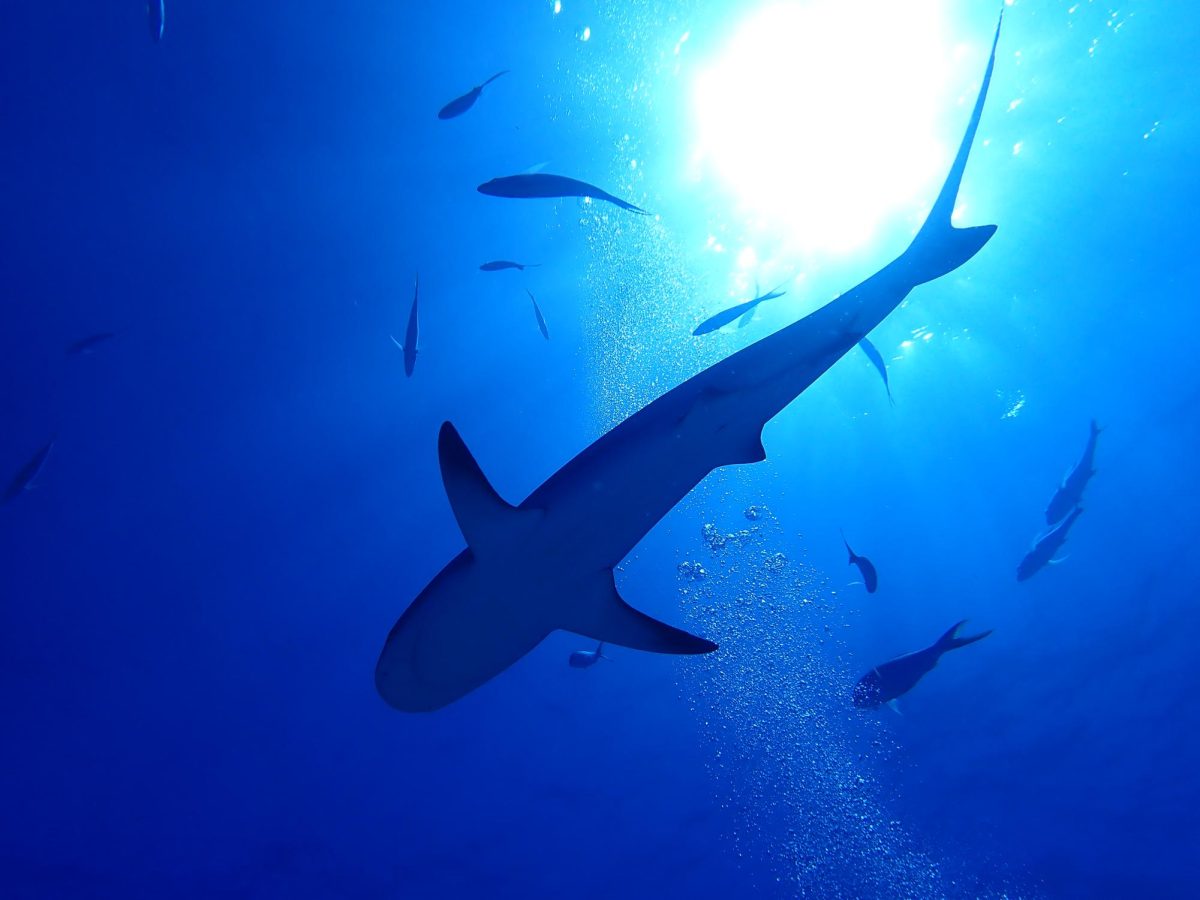
Rhys: Definitely the 14-foot dusky shark we saw during one of our research dives (it was no more than 15 feet away from us). Similarly, the most interesting place we visited was the Glass Window Bridge, where the turquoise Caribbean sea meets the dark blue, vast Atlantic ocean , during a trip to the north of the island.
Stasia: Volunteering with Janara, a 13-year-old Bahamian, cultivated impactful moments. The Deep Creek Middle School Buddy Program was more than just a way to meet someone in the community; it was about building long-lasting connections. Our friendship was built around having lunch together every Thursday, writing songs on Tuesdays, picking mangoes, and her showing me cool dance moves in the pouring rain. Janara and I also encouraged each other to try new things: we both got scuba certified, she performed in a local Junkanoo parade (a kind of festival), and I performed a solo composition at a coffeehouse. We also traveled up north of the island and got to see a Junkanoo parade. The costumes were extremely detailed, filled with vibrant colors, and the community felt connected.
Did you take any interesting classes that we don’t offer here at Taft or that were specific to the work you were doing out in the ocean?
Rhys: I took a sustainable systems class, where we studied water systems and how to sustainably store and use water. On the island of Eleuthera, there is not a surplus amount of water, and heavy rains are rare in the dry season. With our skills in sustainability and the tactics of statistics, we students were able to predict and plan for the future.
Stasia: Marine Ecology was an extremely hands-on class where we got to dissect fish and also go scuba diving to collect data on local marine life. At the end of the course, I proposed where Marine Protected Areas (MPAs) could be placed to protect the coral reefs from dredging and boats. My favorite class by far, though, was my research class. Each [cohort] got to present and publish a research paper: I was in Conch Research, where we went into the field and measured conch populations.
What parts of your time at the Island School, or what lessons you learned while there, do you think you brought back with you to Taft?
Rhys: The skill of strengthening your bond with your inner self. One of the major parts of the curriculum at the Island School is learning how to sit with yourself for long periods of time without any external entertainment (i.e., books, music, technology). These skills and motivations helped us students make it through the 48-hour solo camping experience that was part of our eight-day kayak expedition. This skill is necessary to alleviate the stress of the outside world, and it is named clearly as the most useful teaching of the semester.
Stasia: How to form a community without the use of cell phones. I was able to make long-lasting friendships because there was no distraction of a screen during awkward situations, which forced me to connect with people. I also learned how to be strong in tough times, especially on the 48-hour solo amidst a lightning storm during which I reflected a lot on my life. “Be where your feet are” is what I was told whenever I asked where we were going or what was on the agenda for the day. I will call upon this life-altering phrase when I am balancing the fast-paced, high-achieving society I am conditioned to live in with the freedom, authenticity, and joy of my collective experiences from The Island School. 
What part of the programming excited you the most?
Rhys: The marine biology/research aspect. I, along with the ten other peers in my research group, studied and analyzed the patterns and emotional behavior responses to chumming techniques of our selected species, the Caribbean reef shark. In the research process, we researched the EcoTourism industry and how to best chum the waters to attract sharks, in the most sustainable, safe way. Our findings after holding experiments with the species in real time helped local dive operators located in Eleuthera and around the Bahamas create better, safer, and more sustainable situations for their clients.
Stasia: The part of the program that most excited me was waking up every morning not knowing what the day completely held. There was always something to look forward to, whether it was scuba, an expedition, or participating in an event with the local kids. Overall, the experience has changed who I am as a person. I can take the lessons I learned, channeling the energy from my peers and the empowering experiences, while expressing my gratitude for it all, with the deep understanding of knowing that nothing is as fearful as it seems. It will influence what communities I surround myself in for the rest of my life, and has most importantly confirmed for me how I want to live in this world.
Rhys: For any upcoming sophomore or junior who is interested in the Island School, I highly recommend going. You will not regret it.
Jasset Millhiser ‘27 – High Mountain Institute, Colorado
I know the program doesn’t start until later in January, but what part of it are you most excited about right now?
At the moment, I am most excited to just do new things I have never had the opportunity to do! For example, during one of the camping trips I will be going on, we will literally be sleeping in some type of snow structure similar to an igloo (I think the technical term is “Quigloo,” but don’t take my word for it). Another thing I am excited about is that I still have no idea who else is going to be there; HMI has made a huge point to not send out any lists of the students attending to make sure that everyone meets at the same time, which I think is super unique.
How will HMI help you pursue that passion?
I think one of the main things about HMI that really intrigued me is their devotion to making sure that everyone experiences something new and unique at the same time. As an example, instead of doing traditional skiing, they are having us Telemark ski so that everyone can start from the beginning instead of everyone being on different levels.
What classes did you sign up for, and are any of them different from what we offer here at Taft? Are any of them specific to learning about the Colorado wilderness?
At HMI, most of the classes will be the same as what I was taking [at Taft] in the fall. The only difference is that they have a science course that is unique to them, as it relates to the surroundings of Colorado and [the terrain] where we will be backpacking.