













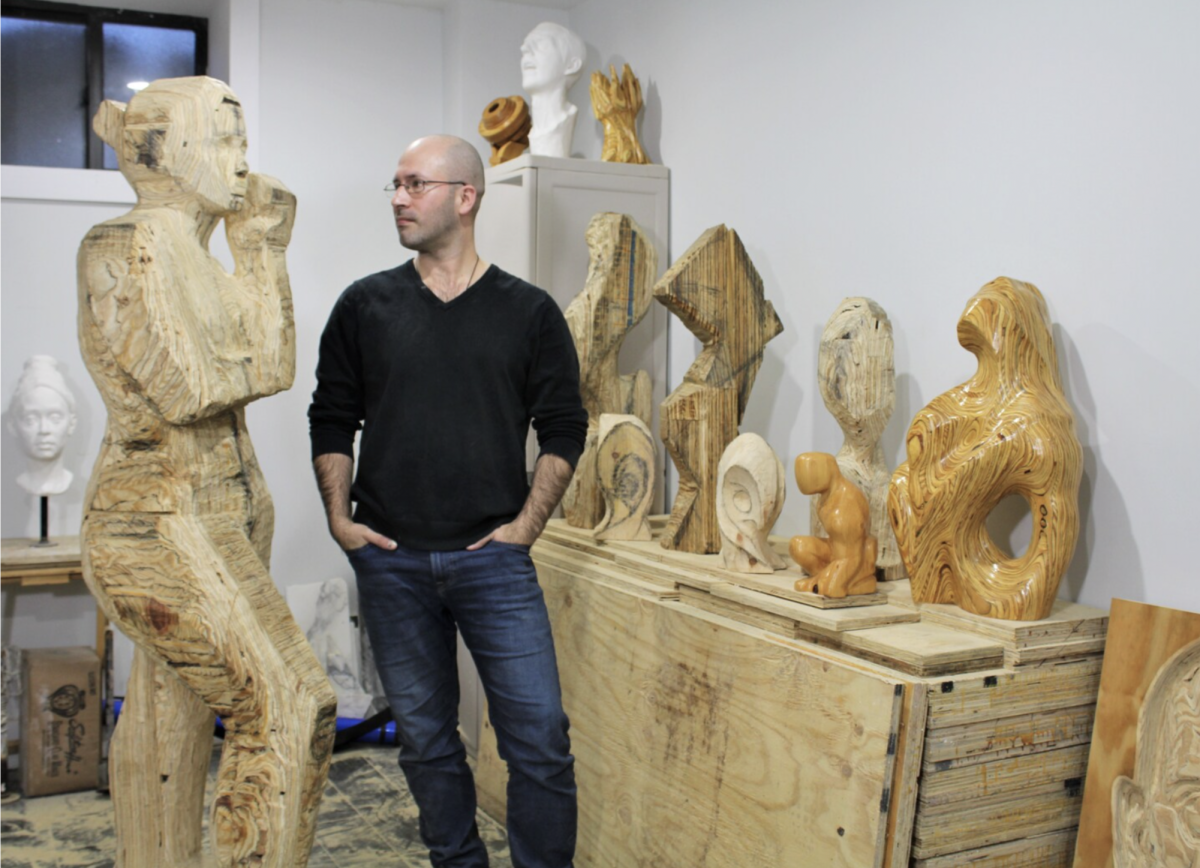
On October 20th, Taft welcomed visiting Latin American artist Jorge “Vascano” Vasquez Elescano and installed a 17-piece series of his celebrated works. During his time on campus, Potter’s Gallery was transformed into an artists’ workshop, where students had the opportunity to experience the different aspects of Vascano’s process, from mediums to practice techniques. When I headed down with my art class, I faced my own trials and tribulations with wood carving: sketching guidelines, perfectly angling my left hand with a chisel, and hacking away with a hammer in my right. Other stations included gluing and blocking wood panels together to demonstrate how he laminates and assembles his sculptures, deconstructing a block of clay to create a simple, geometric face from which details are then carved, and finally practicing sculpting finishing details into wood sculptures using small, precise chisel tools. Of course, the most popular station was the wood carving station, where students had free rein to let out all their anger and frustration on a chunk of wood.
As an art student myself, I found myself captivated and inspired by his display. When I asked him about his work, he responded with such passion and clarity regarding his process that I knew I wanted to learn more about him, so I asked if he would be willing to sit down with me for an interview, to which he happily agreed.
Potter’s gallery introduced me to Vascano and his work, but his works have been widely celebrated. Notably, his work is featured in the Golden Globe and Oscar Academy Award-nominated motion picture, If Beale Street Could Talk, in various publications, including Beautiful Bizarre Magazine, Artnet News, and The Washington Post, and in shows all over the globe in the U.S., Portugal, Denmark, Ireland, and Chile.
Vascano grew up in the vibrant tropics of the Peruvian Amazon and now lives in Washington, Connecticut. When asked about what inspires his work the most, he mentioned that he draws from what he grew up seeing: “the jungle, as an explosion of colors and textures, lit up [his] senses. It’s almost an overstimulation of your senses in a good way.” Beyond his upbringing, Vascano noted that, “another aspect was just curiosity. I like to know how things work from within, so [through my art], I try to go inwards and just see how things work. More objectively, as I grew up, that objectivity switched more to understanding how we are as human beings. My work is a metaphor for understanding that complexity.”
To someone who has never seen Vascano’s work, there is no single way to describe his style. Yet exploration of various materials, colors, and subjects works toward the goal of exploring our inner complexities. Vascano used the metaphor of his “art working as a vehicle [and] a language. To [him], it is a vehicle and a language to discuss the things that are in [his] interest; a fusion that allows [him] to go inward and observe how something feels versus how it looks. [These] are the intricacies and complexities [he] tries to capture through my work.”
The collection of five large, colorful portraits caught my eye; each one was an unclear depiction of one to four different faces, blended and merged, flowing between ages. I asked Vascano who they were, expecting him to tell me they were friends, family, or not real. I was first struck, however, to find that each painting depicted a unique person at each stage of their life, from birth to old age. He then revealed that two of the works, “McIntosh” and “Bohrer,” were both female spies during WWII. Elizabeth McIntosh was stationed in Japan and known for her undercover work, and Doris Bohrer was an American intelligence operative stationed in Europe. When Vascano was finding subjects for these portraits, they both happened to live in the same elderly community. He shared that they “both had very different experiences, so I depicted them differently because when we met, we had extremely different conversations.” Each painting has a range of stories, emotions, and conversations Jorge could point to and share with me.

It is evident even from the selected pieces in Potter’s Gallery that Vascano is a prolific artist who does not confine himself to one niche. When I asked how long it took to complete just one of the 60×40-inch canvases, he told me that he loves to work on many things at once, so as not to get stuck or bored. Interestingly, he doesn’t have a go-to strategy for starting a new piece, and it varies each time. He is always “actively looking for new experiences” since he values selecting personal subjects based on his experiences, then creating sketches or clay models.
One of his favorite pieces, “Petrified,” a laminated marble sculpture of a head, was inspired by a moment of awe. He shared that “that mix of emotions made [him] curious about how [he] could express that inner emotion through this material.”
He shared that his process for this specific piece was as follows: “I made some sketches and drawings on how to represent that inner experience, and then I started to assemble the blocks accordingly, based on how I felt the outcome might look. But it’s never what you anticipate, because you can’t see the blocks when you first start. It’s always a surprise what you reveal through the extraction of the material at the end. It’s more of an organic way to pick my subjects. If you know exactly how a piece is going to turn out from the beginning to the end, something is wrong with the process. You want to have discoveries. Additionally, all my sculpture pieces begin with an idea of what the sculpture will be, and I strive to achieve that particular feeling. But at the end, I never know what is going to happen, but I see that as a good thing. I like to be surprised, and it’s surely a good way to make sure I’m not bored.”
And then I asked the question that you should never ask a creator: “What is your favourite work?” It’s like asking a parent to pick a favourite child. Vascano was first hesitant to make a decisive choice, since “each of them is different. All the subjects come from a personal place; they work as actors. Through them, I research a particular trait or feeling that I see in these subjects. I recognize my own humanity through the humanity of others.” But after some prying, he told me that the following pieces were “not really favorites, but some [he] felt that [he] dug out deeper, and [got] more satisfaction from.” The first being Petrified, the earlier-mentioned laminated marble sculpture. The second, not displayed at Taft, is called Silence, created in a particularly tough time in Vascano’s life, but serving as an outlet to channel his energy and feelings.

There is much to be learned from simply observing Vascano’s work and learning about his methods. But, Vascano also experienced positive takeaways from his time at Taft, stating: “I really enjoyed the curiosity of the students here, how engaged they were, the questions they had, and to see that they really wanted to learn. It was refreshing to see how interested they were in my process and a good way to articulate my own thought process.”
For budding artists, Vascano’s advice is to “trust your instincts. It’s a good way to know that you are going in the right direction. I think one of the hardest things to find as an artist, or in any creative field, is your voice. The subjects that come from a personal response tend to be the ones that your voice tells you to go in that way.” Even if you don’t want to be a professional artist, his advice to “remain perseverant and determined” applies to all.
Vascano’s work will remain on display until December 20th, so be sure to stop by and take a look for yourself!